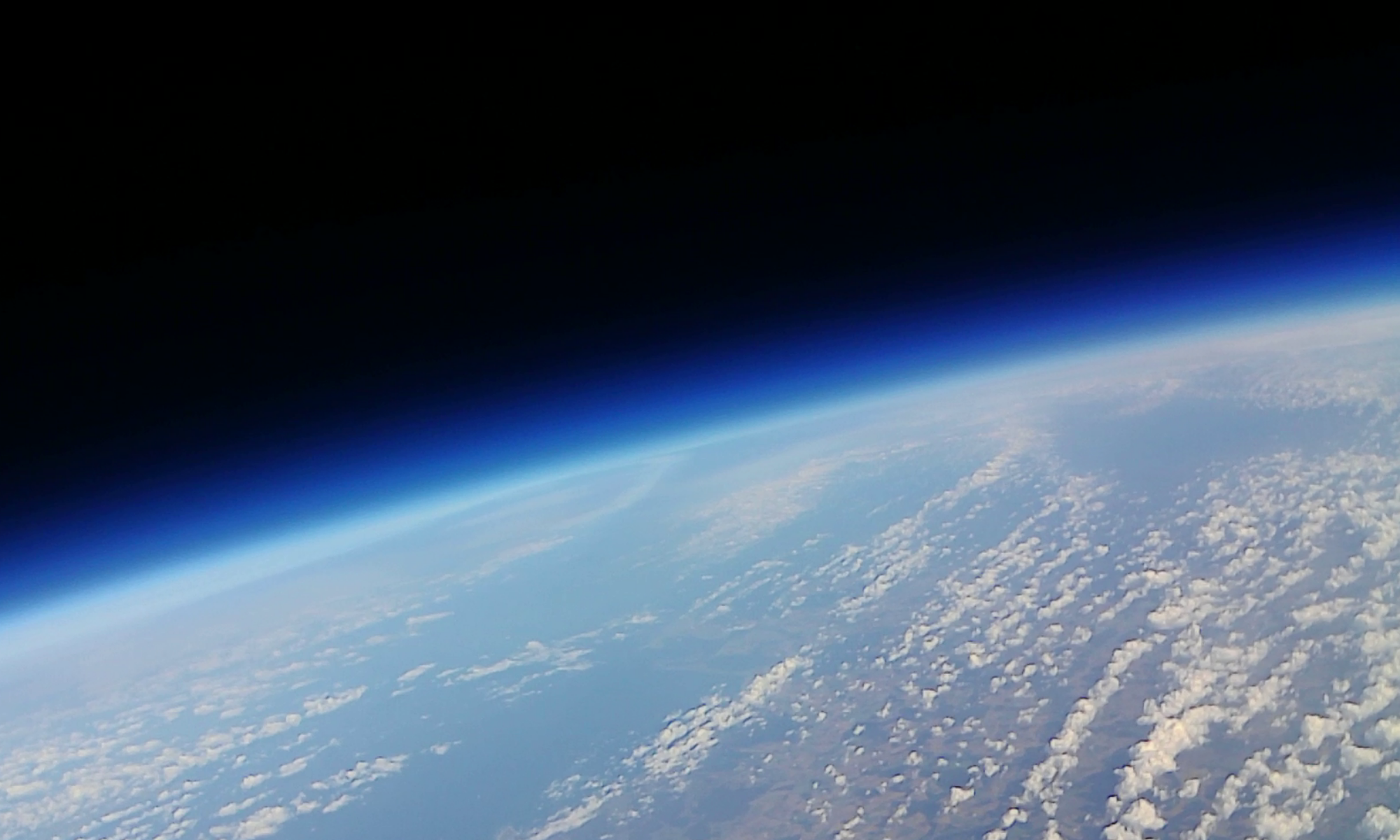
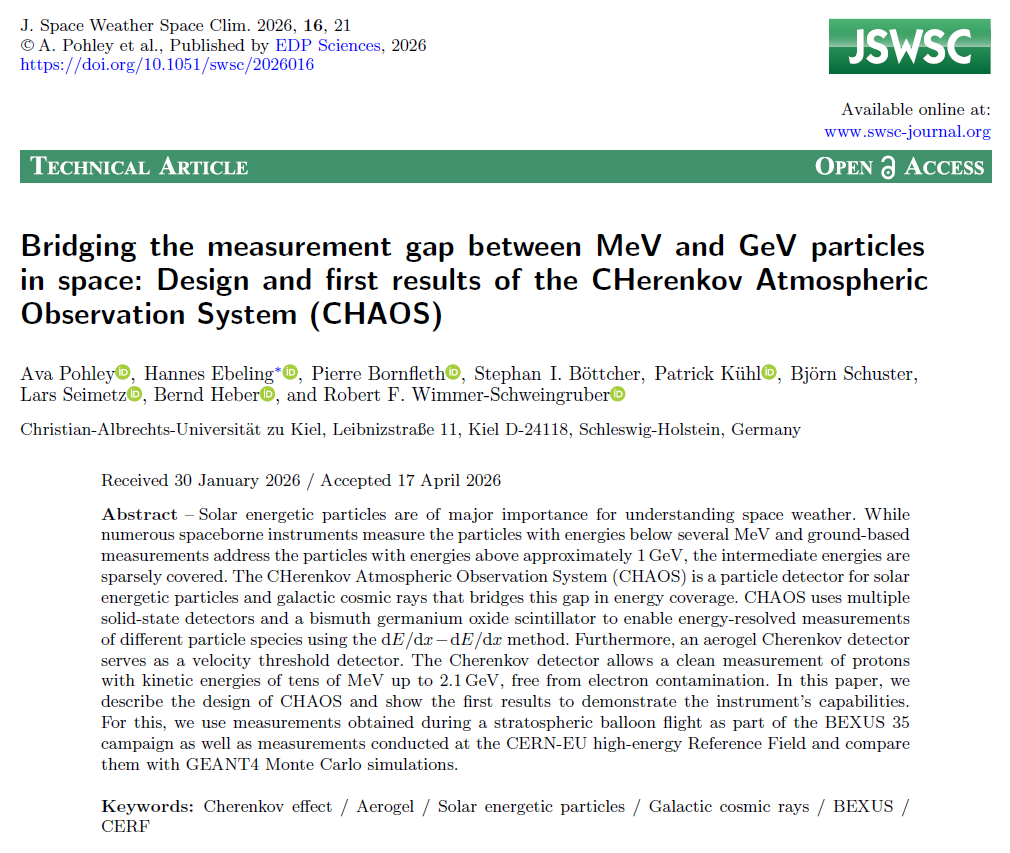
Three years after our first team meeting in 2023, we were able to publish a paper presenting the results of our CHAOS experiment. Developed by a team of students as part of the BEXUS 35 campaign, CHAOS was launched on a stratospheric balloon in northern Sweden in October 2024 to measure galactic cosmic rays. Another measurement campaign was performed at CERN in May 2025. By combining measurements from these two campaigns with Monte Carlo simulations, we showed that CHAOS can separate electrons from protons with kinetic energies of tens of MeV up to 2.1 GeV. For the particle separation, CHAOS uses its aerogel Cherenkov detector, which serves as a velocity threshold detector. The CHAOS design can be used to measure solar energetic particles, making it interesting for the space weather community.
We want to thank everyone that was involved in CHAOS’s journey and helped us to let this student project result in a publication. Special thanks go to the REXUS/BEXUS programme and the Department for Extraterrestrial Physics at Kiel University.
You can download the paper on CHAOS here.
Pohley A., Ebeling H., Bornfleth P., Böttcher S.I., Kühl P., et al. 2026. Bridging the measurement gap between MeV and GeV particles in space: Design and first results of the CHerenkov Atmospheric Observation System (CHAOS). J. Space Weather Space Clim. 16, 21. https://doi.org/10.1051/swsc/2026016.
This is an Open Access article distributed under the terms of the Creative Commons Attribution License (https://creativecommons.org/licenses/by/4.0), which permits unrestricted use, distribution, and reproduction in any medium, provided the original work is properly cited.