GRETEL: Let’s start a Devlog

A new Instrument for the Kiel Fleet

A new project is taking shape at Kiel University: The Galactic Ray high-Energy Telescope, GRETEL.
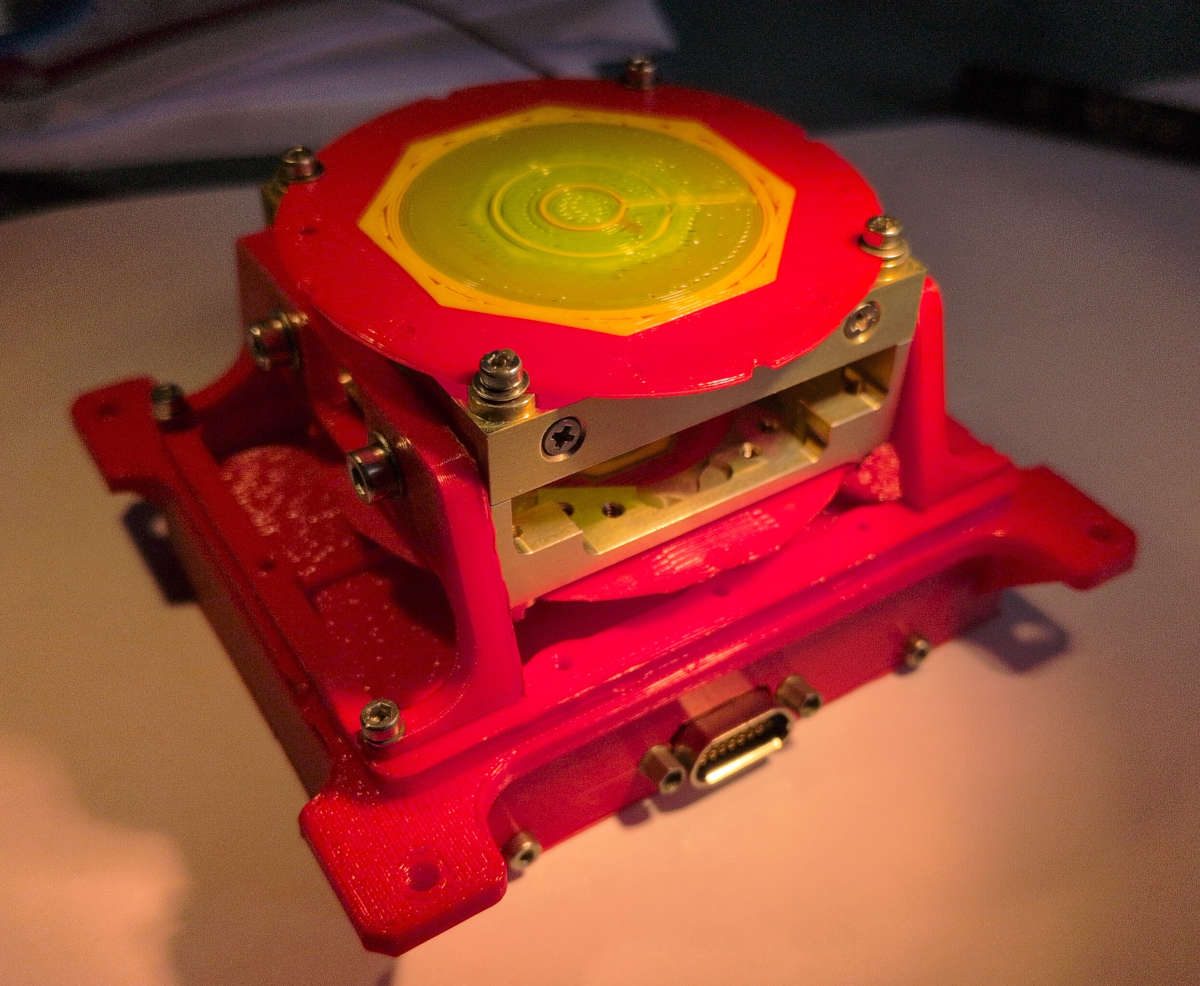
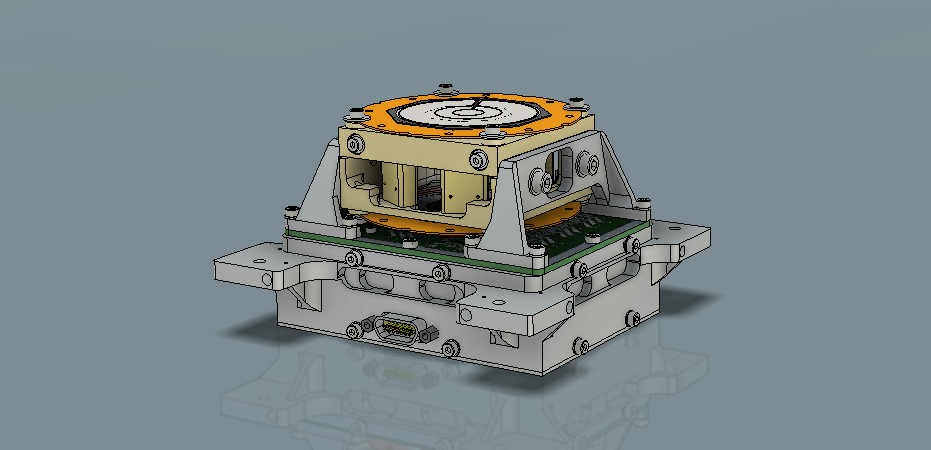
3D-printed mockup of GRETEL

GRETEL takes a proven concept and scales it down to fit into a CubeSat. The concept is very similar to the High Energy Telescope aboard Solar Orbiter, (and actually uses spare parts): Two solid-state detectors positioned symmetrically around a scintillation crystal. When highly energetic particles penetrate the detectors, they deposit part of their energy there. These signals are picked up and measured by the electronics.

A Northern German Collaboration
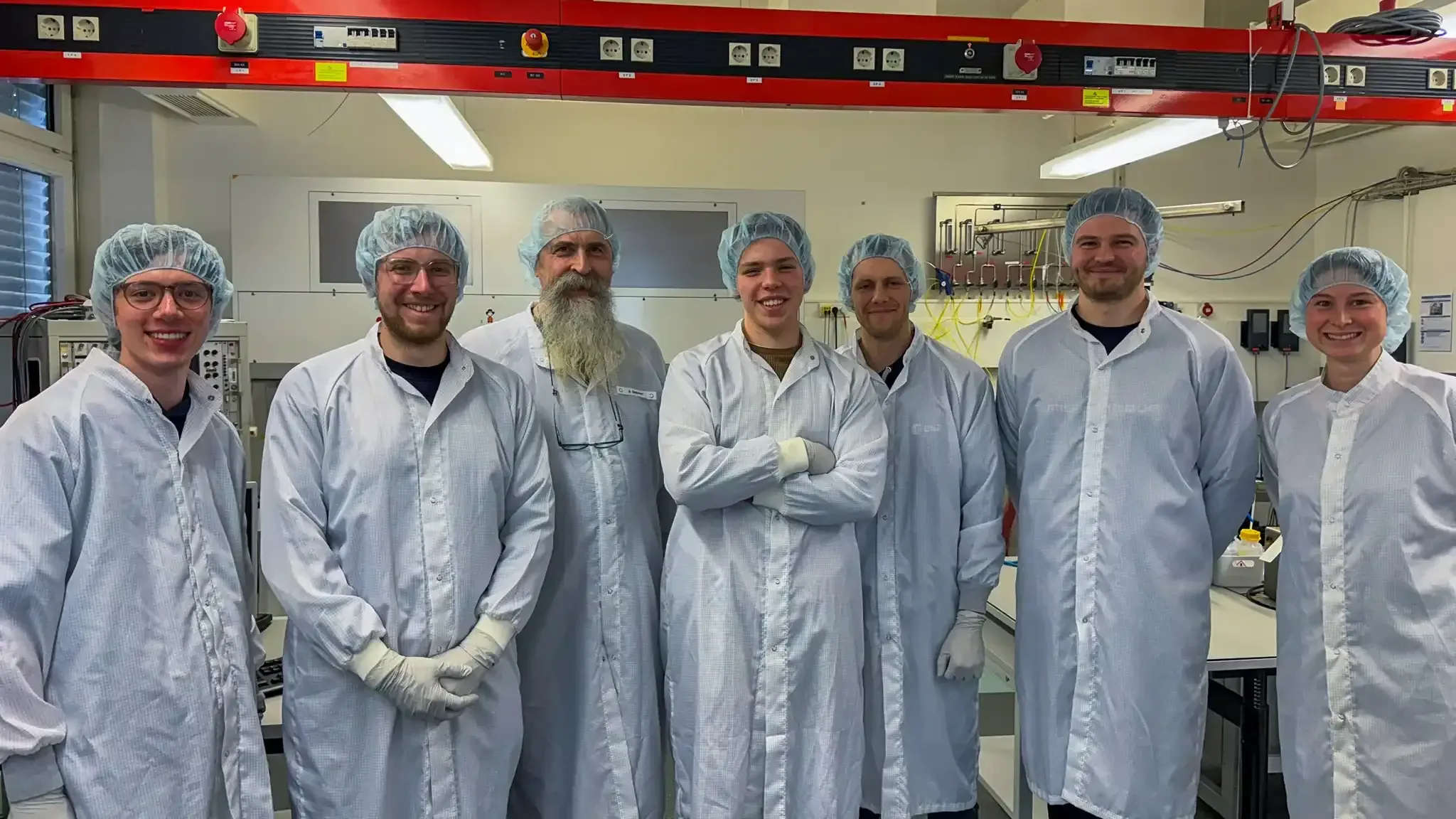
Members of the Hamburg Space Team visiting Kiel

GRETEL is being developed in collaboration with the Hamburg Space Team, located at the Technical University of Hamburg. The newly founded team aims to launch the CubeSat mission Hamburg Autonomous Northern lights Survey (HANS) within the next years. GRETEL will fly as a scientfic payload on this mission.

Find out more about Hamburg Space Team on https://hamburgspace.de .

Work In Progress

GRETEL is being developed as part of my Master’s thesis. Currently, I am working on particle transport simulations to investigate the instrument’s response to different types and energies of radiation. At the same time, the workshop has finished machining the first components. Soon the shiny aluminum prototype will be ready for assembly!
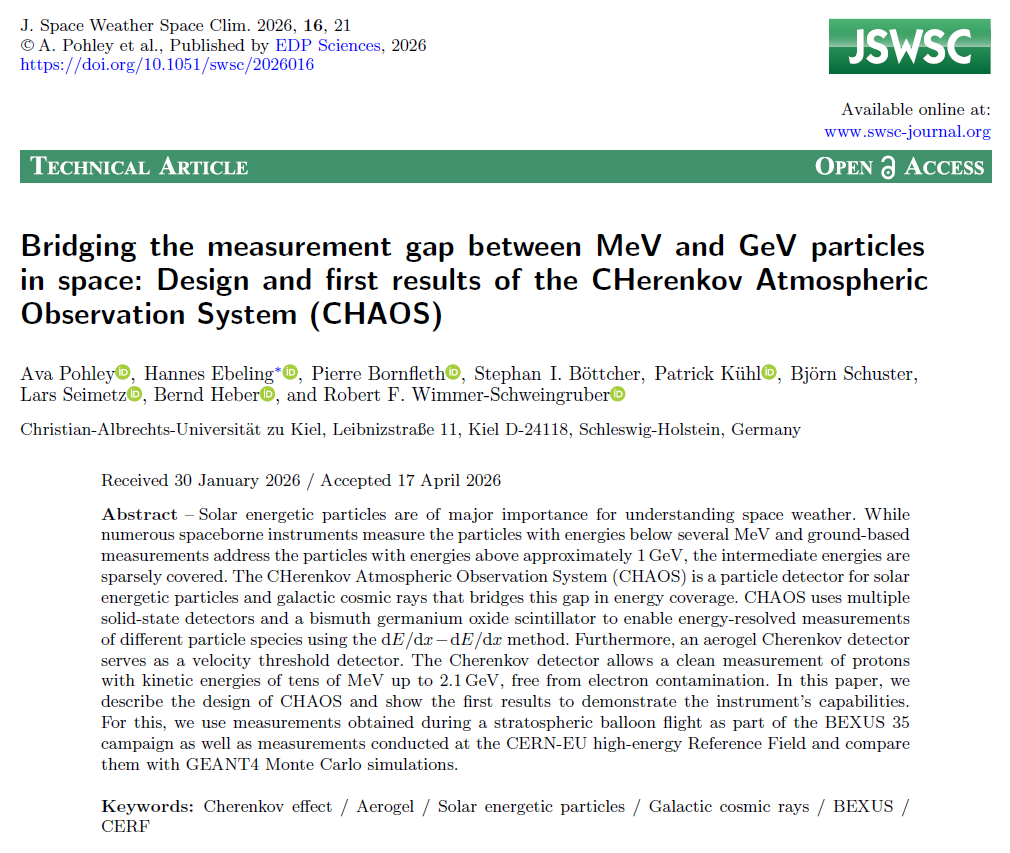
We published a paper on CHAOS!

Three years after our first team meeting in 2023, we were able to publish a paper presenting the results of our CHAOS experiment. Developed by a team of students as part of the BEXUS 35 campaign, CHAOS was launched on a stratospheric balloon in northern Sweden in October 2024 to measure galactic cosmic rays. Another measurement campaign was performed at CERN in May 2025. By combining measurements from these two campaigns with Monte Carlo simulations, we showed that CHAOS can separate electrons from protons with kinetic energies of tens of MeV up to 2.1 GeV. For the particle separation, CHAOS uses its aerogel Cherenkov detector, which serves as a velocity threshold detector. The CHAOS design can be used to measure solar energetic particles, making it interesting for the space weather community.

We want to thank everyone that was involved in CHAOS’s journey and helped us to let this student project result in a publication. Special thanks go to the REXUS/BEXUS programme and the Department for Extraterrestrial Physics at Kiel University.

You can download the paper on CHAOS here.

Pohley A., Ebeling H., Bornfleth P., Böttcher S.I., Kühl P., et al. 2026. Bridging the measurement gap between MeV and GeV particles in space: Design and first results of the CHerenkov Atmospheric Observation System (CHAOS). J. Space Weather Space Clim. 16, 21. https://doi.org/10.1051/swsc/2026016.

This is an Open Access article distributed under the terms of the Creative Commons Attribution License (https://creativecommons.org/licenses/by/4.0), which permits unrestricted use, distribution, and reproduction in any medium, provided the original work is properly cited.